Proofpoint attributed a July credential phishing campaign to TA419, a China-aligned espionage group that impersonated named US policy figures to steal cloud account credentials from AI experts. On July 8, the actor posed as Lynne Edwards Parker, former principal deputy director of the White House Office of Science and Technology Policy, and later as economist and foreign policy expert Heidi Crebo-Rediker. An earlier February operation from the same group impersonated an Anthropic employee to target an AI policy expert at a US think tank. This analysis draws on reporting from Dark Reading.
The targeting set is narrow and deliberate. Proofpoint has tracked TA419 running regular credential phishing against people at US- and Japan-based think tanks, defense contractors, universities, and law firms since at least April 2025. The goal is access to cloud accounts belonging to individuals who shape or advise on AI policy, export controls, and technology regulation. If your firm employs policy analysts, outside counsel working on export compliance, or researchers with federal or academic ties, those mailboxes hold exactly the correspondence this campaign is collecting.
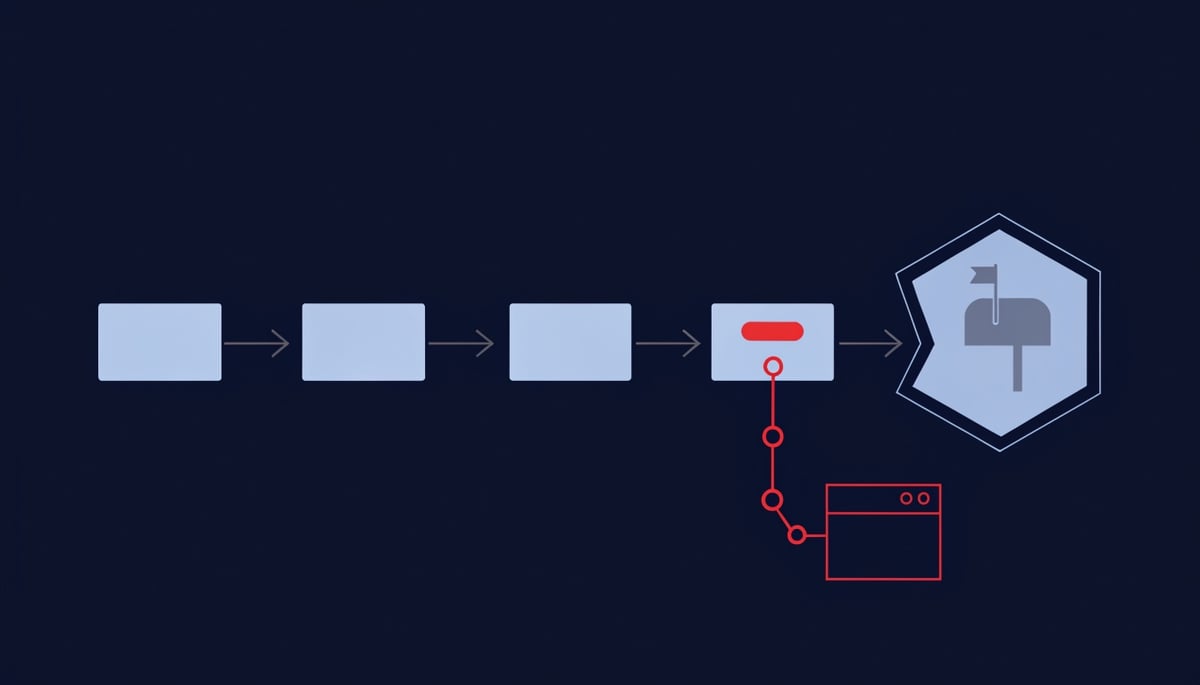
What separates this from routine phishing is the pacing. TA419 opened with benign outreach, inviting targets to join a fictitious "AI Policy Advisory Committee" or to contribute to a Senate Committee on Foreign Relations report on AI export controls and supply chains. Only after the target replied did the group send a shortened URL that ran through a multistage redirection chain to a fake OneDrive adversary-in-the-middle (AiTM) page, built on a customized version of the open source Frameless BitB browser-in-the-browser tool. Because the AiTM page sits between the victim and the real authentication service, it captures the authenticated session alongside the password.
"Most organizations are vulnerable to this attack, despite having confidence that their MFA will protect them," says Steven Swift, managing director of Suzu Labs. The MFA prompt still happens. "It just happens at a point in the attack where it doesn't help."
How Frameless Browser-in-the-Browser Attacks Defeat URL Inspection
The phishing page in this campaign ran on a customized build of Frameless BitB, an open source browser-in-the-browser kit. The name describes the technique: the fake login window is drawn with HTML, CSS and JavaScript directly in the page document instead of being loaded into an iframe.
That design choice matters for defenders. Classic BitB kits embedded a nested frame to hold the spoofed login form, which meant they tripped over frame-focused controls and inspection logic. Microsoft and other identity providers already set X-Frame-Options and Content-Security-Policy: frame-ancestors headers that block their real sign-in pages from being framed, and many web filters and browser isolation products pay close attention to cross-origin frame behavior. A frameless implementation sidesteps all of it because there is no second browsing context to flag. The entire window, including the title bar, the tab, the minimize and maximize controls and the address bar, is just styled markup inside the attacker's own page.
The address bar is the part that does the work. It is a text element the attacker fills with whatever string they want, typically a Microsoft or OneDrive sign-in URL complete with a drawn padlock glyph. The genuine browser address bar still shows the attacker-controlled host, but it sits above a convincing fake window that most people read as the authoritative one. Proofpoint noted the victim reached that host through a shortened URL and a multistage redirection chain, which also breaks up static URL reputation checks at the mail gateway.
Realism gets reinforced with behavior. These kits make the spoofed window draggable and resizable so it responds to a mouse the way a real popup would. The giveaway is that the fake window cannot leave the boundaries of the parent page or move onto a second monitor, and its padlock is not clickable, so there is no certificate detail panel behind it. There is no genuine browser-level TLS indicator on that window because the window is not a window.
Behind the rendered form sits the adversary-in-the-middle relay. Credentials typed into the fake OneDrive prompt get proxied to the real Microsoft endpoint in real time, the identity provider issues a genuine MFA challenge, and the victim approves it on their own phone. The authentication succeeds because it actually happened. The attacker captures the resulting session cookie and replays it to reach the mailbox and cloud files without facing a second MFA prompt.
"It just happens at a point in the attack where it doesn't help," said Steven Swift of Suzu Labs, describing why MFA completes normally during these attacks.
For your organization, the practical consequence is that a successful push approval in the authentication log is not evidence of a legitimate sign-in. The stolen session gives an operator the same mailbox access, SharePoint access and directory visibility as the account owner, with no malware on the endpoint for an EDR agent to find.
In ATT&CK terms the chain runs through T1566.002 (spearphishing link), T1204.001 (user execution of a malicious link), T1557 (adversary-in-the-middle), T1539 (steal web session cookie) and T1550.004 (use of a stolen web session cookie). The pretext stage, several exchanges of subject-matter conversation before any link appears, maps to T1585 and T1656 impersonation activity, which means the first malicious artifact in the whole sequence may be the shortened URL that arrives in message four or five.
Why Conversational Impersonation Beats Traditional Phishing Filters
The opening message in this campaign gives a secure email gateway nothing to act on. No attachment, no URL, no spoofed display name pointing at a lookalike domain. Proofpoint describes benign outreach inviting the target to join a fictitious "AI Policy Advisory Committee" or to contribute to a Senate Committee on Foreign Relations report on AI export controls and supply chains. That is a plain-text professional inquiry, and it scores like one.
This stage maps to T1598 (Phishing for Information) rather than T1566, and the distinction matters operationally. Gateway verdicts are driven by attachment detonation, URL reputation, sender domain age, authentication results and body-content signals. A short, grammatical, topic-appropriate message from a sender with no prior bad history produces none of those signals. Your filtering stack does not get a meaningful decision point until the second or third message in the thread.
The delivery of the actual payload is reply-gated. Proofpoint notes the shortened URL only follows if the target responds, which produces two effects defenders should understand:
- Recipients who ignore the approach never receive anything malicious, so the campaign generates very few of the artifacts that feed detection telemetry and threat intel sharing.
- When the link does arrive, it lands inside an established thread with quoted history, a consistent subject line and a sender address that has already exchanged friendly correspondence with the mailbox.
- The shortened URL conceals a multistage redirection chain, so static inspection of the visible link resolves to a shortening service rather than the final credential-harvesting host.
Reputation-based filtering is built on the assumption that a sender's history predicts its next message. Here the attacker manufactures that history deliberately, one benign exchange at a time, before the malicious stage ever runs. For a security team, this means sender reputation and thread continuity become attacker-controlled inputs rather than independent evidence.
The impersonation layer (T1656) works on the same principle. TA419 selected real, publicly verifiable people whose professional focus matches the target's own work, so a recipient who searches the name finds a genuine career record, real publications and real institutional affiliations. Confirming the person exists is not the same as confirming the person wrote the email, and the pretext is constructed so that the first check a careful recipient performs comes back clean.
Sustaining this requires something older phishing kits never needed, which is the ability to hold a credible exchange about export controls, supply chain policy and AI regulation across several messages. Proofpoint does not attribute the text to any language model, though the broader availability of generative tooling has reduced the cost of producing fluent, subject-matter-correct correspondence at volume. For a small research team, that shifts the threat from a single suspicious email to an ongoing correspondence that has to be judged on its merits.
The targeting is selective for a reason. Proofpoint assesses the activity supports Chinese intelligence objectives around US AI policy and regulatory developments, set against accusations of model distillation and active export control disputes. A compromised cloud account belonging to an AI policy expert yields draft positions before publication, correspondence with government and industry contacts, and the target's collaborator network, which supplies the next round of credible pretexts. Credential theft at one think tank researcher therefore produces both intelligence and the raw material for the following campaign.
Operational and Research Exposure for Targeted Organizations
When TA419 captures an authenticated session, the attacker inherits whatever that account can reach. For a think tank or university research group, that means the draft reports, pre-publication analysis, grant proposals and internal position papers sitting in a single researcher's mailbox and cloud drive. None of it is classified in most cases, and all of it is useful months before it becomes public.
The persistence problem is what makes this expensive. Because the stolen session can be reused without completing multifactor authentication again, your user sees no second prompt, no password reset request and no obvious failure. Collection continues quietly while the account behaves normally from the inside, so the window between the first successful login and discovery is often measured in collection cycles rather than hours.
Your compromised mailbox then becomes useful for a second purpose. Attackers reading a real thread between your policy director and a congressional staffer, a foundation program officer or a defense contractor can continue that conversation from the legitimate account. Partners receive messages from an address they have corresponded with for years, with correct history, correct tone and correct subject matter.
- Funders and grant bodies who trust your institutional domain and have no reason to verify a reply in an existing thread.
- Government contacts whose own mailboxes become the next target, with your organization named as the referrer.
- Peer researchers at other universities and law firms who get pulled into the same credential capture through what looks like a colleague's introduction.
That is where reputational cost lands. Your staff are not just victims in this scenario, they are the delivery mechanism used against the people who fund and rely on your work. Explaining that to a board, a donor or a partner institution is a different conversation than explaining a server breach.
There is also a contact exposure problem that does not resolve with a password reset. Policy research runs on named sources, off-record interviews, contributor lists and reviewer identities. An attacker with mailbox access reads who spoke to you, what they said and under what conditions, and that information cannot be recalled. For individuals in or connected to China, or for collaborators working on export controls and supply chain questions, that exposure carries consequences for them personally that your organization cannot undo.
Legal obligations may follow. If your researchers handle controlled technical data, or hold correspondence tied to federally funded work, export control and research security reporting requirements can be triggered by unauthorised foreign access to that material. Determining whether a reportable event occurred requires knowing exactly which files and messages were readable during the access window, which is difficult to reconstruct after the fact and slower when the account looked normal throughout.
Operationally, the recovery work falls on people you cannot easily backfill. Your principal investigators and policy leads are the ones who must review what was in their mailboxes, contact every affected source, notify funders and support legal review. That time comes directly out of research output, and it arrives alongside the uncomfortable task of telling peer institutions that correspondence from your domain should be treated as suspect for a defined period.
Proofpoint expects this impersonation and phishing pattern to continue as TA419 activity becomes better understood, so the exposure described here applies to repeat targeting rather than a single incident.
Detection and Hardening Steps Against BitB Credential Theft
Start with FIDO2/WebAuthn passkeys for anyone who writes, reviews or comments on AI policy, and for the executives and comms staff who speak publicly on their behalf. Passkeys bind the credential to the real origin at the protocol level, so a spoofed sign-in window drawn on an attacker-controlled domain never receives anything it can replay. That single control removes the value of the entire redirection chain described earlier, which is why it outranks every awareness measure on this list.
Telling users to "check the URL" does not hold up against this technique. The address bar they are inspecting is page content, and the user approved the MFA prompt themselves, so nothing about the sequence feels wrong. Treat training as support for origin-bound authentication, never as a substitute for it.
Three actions belong in your first week:
- Revoke active sessions and refresh tokens for high-risk staff, then audit OAuth application grants in your tenant for consents you cannot trace to a business request. Token revocation is the only step that ends access the attacker already holds.
- Brief research, policy and communications teams on the specific pretext: unsolicited contact from a named government or former government figure, an invitation to an advisory body, a request to contribute to a report, or a request for an interview or peer review.
- Publish an out-of-band verification procedure. Staff confirm claimed government or institutional affiliation through a phone number or email address they look up independently, never one supplied in the message thread.
For alerting, prioritize sign-ins from hosting provider ASNs and residential proxy ranges, impossible-travel pairs within short windows, and new mail forwarding or inbox rules created shortly after a successful authentication.
Over the next quarter, tighten the conditions under which authentication is accepted at all. Block legacy authentication protocols that cannot enforce modern controls, require compliant or managed devices for access to mail and cloud storage, and shorten session lifetimes for accounts holding pre-publication research. Deploy an enterprise password manager and let its behavior work as a detection signal: if it declines to autofill, the origin does not match the real sign-in domain, and users should be taught to treat a silent vault as a stop condition rather than typing credentials manually.
Tune your mail platform for the impersonation pattern itself. Enable impersonation protection covering the display names of senior staff, well-known external researchers and officials your people correspond with, and keep external-sender banners visible on every inbound message including replies within a thread. Add monitoring for newly registered domains that resemble your own institution and the government bodies your staff engage with, since those registrations frequently appear before outreach begins.
Finally, change what your simulations test. Most phishing exercises measure whether someone clicks a link in a cold email, which this group never sends first. Run scenarios that open with a multi-message professional conversation and end in a spoofed login window, and measure how many staff pause to verify the sender through an independent channel. That number tells you more about your exposure to TA419-style operations than click rates do.
What Security Teams Should Prioritize Next
The thing worth carrying out of this campaign is that TA419 spent weeks earning a reply before it ever sent anything a security control could inspect. If your organization produces AI policy research, legal analysis of export controls, or advisory work for government bodies, your people are the collection target, and the credential is simply the route to the material. Proofpoint expects this pattern to continue as the group's activity becomes better understood, and the same approach transfers cleanly to any sector where a plausible professional invitation is routine.
Two consequences follow for how you set priorities. The first is that your highest-risk population is small and nameable: the researchers, counsel, and subject-matter staff whose names appear on published work and conference agendas. That group is where origin-bound, phishing-resistant authentication earns its cost, because it is the one control that holds when the user is cooperating with the attacker in good faith. Everything else in your stack is reacting to a login that looks correct.
The second is that your detection effort belongs after the sign-in, not before it. You are not going to reliably catch a benign email about a Senate committee report, and tuning your gateway to try will cost you more in false positives than it returns. What you can see is what the session does once it exists: where it connects from, what it reads, what rules it creates, and how long it lives.