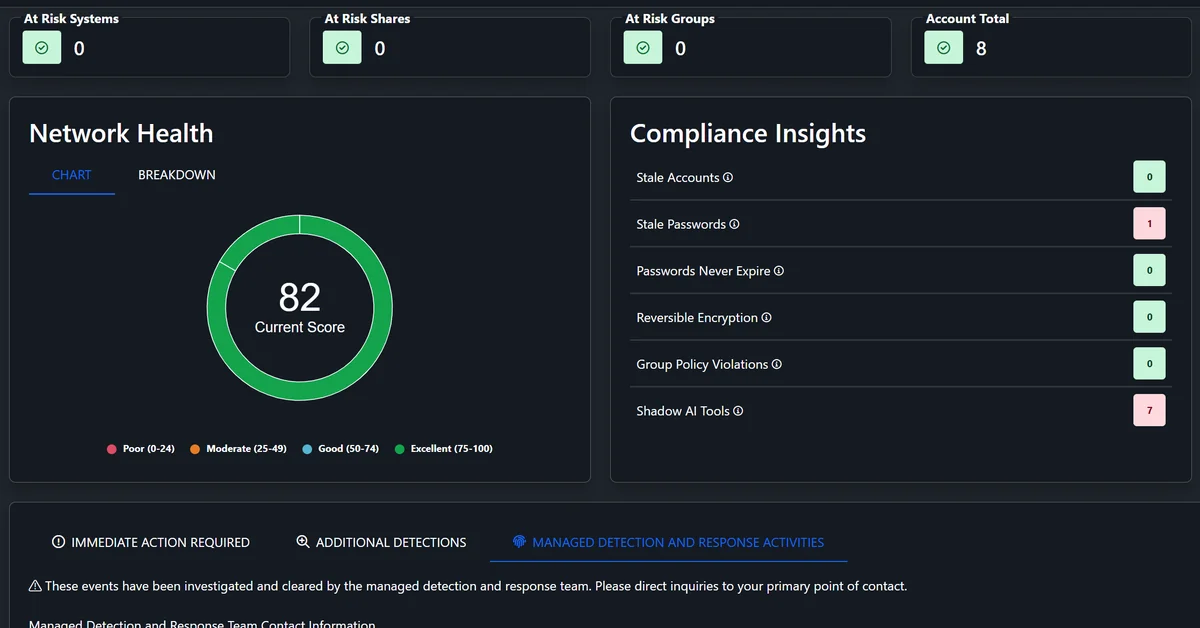
Health-ISAC's July 24 advisory reports an increase in successful ShinyHunters intrusions at healthcare and medical technology organizations, built on voice phishing that ends in a compromised single sign-on account. The advisory does not name affected organizations or give incident counts, but BleepingComputer has confirmed recent ShinyHunters activity at Medtronic, DentaQuest, iRhythm, and OneMedical. The DentaQuest breach alone exposed information tied to 2.6 million accounts. (Source: BleepingComputer)
The business consequence starts with what one SSO account reaches. When an attacker signs in to your Okta, Microsoft Entra, or Google dashboard as a real employee, they inherit that person's access to every connected application at once:
- Salesforce, a primary ShinyHunters target, holding patient, payer, and provider relationship records
- Microsoft 365 and SharePoint, where clinical documents, contracts, and internal correspondence accumulate
- DocuSign, Dropbox, and Google Drive, which frequently hold signed consent forms, trial documentation, and vendor agreements
- Slack and Atlassian, where engineering and operations teams discuss system access and unreleased device work
In recent incident reporting to Health-ISAC, ShinyHunters claimed it vished multiple employees, took over a Microsoft Entra SSO account, and pulled data from Microsoft 365, SharePoint, and other enterprise platforms. Health-ISAC notes that not every claim has been verified, and advises defenders to treat the pattern itself — compromised SSO identity, then bulk access to connected cloud services — as the thing that matters.
"SSO is the control plane, and ShinyHunters' leverage is created through data theft at cloud scale," Health-ISAC warned.
What separates this from commodity phishing is the tooling. ShinyHunters operates custom phishing kits designed for live voice interaction, with a command-and-control panel that lets the caller change page content and push authentication dialogs in real time while the call is in progress. Your staff awareness training built around spotting a badly written email does not apply to a phone call where the attacker adjusts the fake login screen to match whatever the employee says they are seeing.
The other structural difference is where the attack begins. ShinyHunters has spent the past two years breaching third-party integration partners to harvest OAuth tokens for SaaS platforms like Salesforce and Snowflake, which means your exposure is not limited to your own employees. A vendor's compromised integration can produce data loss in your tenant without a single one of your accounts being touched.
Helpdesk staff are the pressure point that turns a phone call into account access. The chain described in the advisory runs through requests to reset a password, change an MFA method, or enroll a new device — routine tickets your service desk closes dozens of times a week. In healthcare, where clinicians call in at shift change and need access restored quickly, the operational incentive to resolve those requests on the spot works in the attacker's favor.
Because this is data theft and extortion rather than encryption, the cost profile differs from ransomware. You face breach notification obligations across every jurisdiction where affected patients live, contractual exposure to payers and device customers, and extortion pressure applied while stolen records sit outside your control. Stolen ShinyHunters data has also been recycled into downstream fraud against individuals, including a sextortion email campaign demanding $2,000 from people whose details appeared in the leaks — meaning your patients absorb harm long after your incident response closes.
ShinyHunters' Custom Phishing Kit: Attack Chain and Delivery Methods
The distinguishing feature of ShinyHunters' tooling is that the phishing kit is driven by a live operator rather than a static page. BleepingComputer reported the group uses custom kits built specifically for voice-based social engineering, and Okta documented a command-and-control panel that gives the caller real-time control over authentication flows.
That matters because it changes the tempo of the attack. A conventional credential-harvesting page shows the victim one fixed screen and hopes they type something into it. Here, the operator on the phone watches the session and pushes the next dialog on cue.
- Content swapping mid-call: the attacker changes page text and branding as the conversation progresses, so what the employee sees matches what the "IT technician" is describing.
- On-demand authentication dialogs: the panel displays password prompts, MFA challenges, and device-enrollment screens at the moment the caller asks for them, which makes one-time codes usable inside their short validity window.
- Operator-controlled sequencing: the flow branches based on how the victim responds, rather than following a single scripted path.
Off-the-shelf kits sold on criminal markets are mostly template bundles or adversary-in-the-middle proxies that run unattended. A hands-on-keyboard panel tied to a phone call is a different operating model: it defeats the "does this page look right?" instinct because a human is explaining the page while you look at it.
The chain Health-ISAC describes in its July 24 advisory begins before any page is loaded. The vishing call targets either the account holder or the helpdesk, and the ask is a password reset, an MFA method change, or enrollment of a new device (MITRE T1566.004, spearphishing voice, feeding T1556.006 and T1098.005, account manipulation through device registration).
Enrolling a new authenticator is the pivot point. Once the attacker's own device is a registered factor, they no longer need the victim, the stolen code, or the phishing page — they hold a durable authenticator on the account and can sign in repeatedly (T1078.004, valid cloud accounts). For a hospital or device manufacturer, that means the intrusion is not a single fraudulent login event but standing access that looks legitimate in audit logs.
From there the operator authenticates to the identity provider and works outward into connected services. Health-ISAC's recent incident reporting describes ShinyHunters claiming it vished multiple employees, took over a Microsoft Entra account, and pulled data from Microsoft 365, SharePoint, and other enterprise platforms — collection from cloud repositories (T1530) followed by exfiltration over web services (T1567). The organization notes not every claim has been verified, and directs defenders to the pattern rather than the individual boasts.
Running parallel to the identity route is the group's supply chain work against third-party integration partners. Those breaches yield OAuth tokens issued for SaaS integrations with platforms including Salesforce and Snowflake — stolen application access tokens (T1528) that authenticate as an approved app instead of a user, so no password or MFA factor is involved at all. Salesforce has been a primary target.
The advisory publishes no domains, IP addresses, or sender patterns, and does not state how many incidents were observed. The observable artifacts are behavioral: new MFA factor registrations, newly enrolled devices, unfamiliar OAuth grants, unusual API call volume, and bulk file downloads shortly after a helpdesk reset ticket. Health-ISAC's framing is that the identity provider is the control plane, and data theft at cloud scale is what the group converts that access into.
Immediate Detection and Response Actions for Healthcare Networks
Following the NIST Cybersecurity Framework, the sequence below moves from what you check today through what Health-ISAC says should be finished inside 30 to 60 days.
Identify
Start by pulling every MFA factor registration and device enrollment event from your identity provider for the past 30 days, and reconcile each one against a helpdesk ticket. Any reset or enrollment with no matching ticket is your first investigation queue.
In parallel, inventory the OAuth grants, API tokens, and third-party integrations already connected to your tenant. You also need a written list of high-risk identities — executives, IT administrators, security staff, helpdesk personnel, and finance employees — because those are the accounts that get extra verification in the next step.
Protect
The single most important change is a "no same-call" policy at the helpdesk: no password reset, MFA reset, or device re-enrollment happens during the inbound call that requested it. Require a support ticket, then a callback to a previously verified number, with manager approval for privileged accounts.
Once that's in place, deploy phishing-resistant MFA — FIDO2 or WebAuthn security keys — to administrators, helpdesk staff, executives, and the rest of your high-risk list. Disable or tightly restrict SMS and voice-based authentication, and require a managed device or a conditional access policy before any new MFA factor can be registered.
Treat your SSO platform as a Tier 0 asset, the same tier as domain controllers. That means blocking legacy authentication, limiting administrative portals to managed devices, and requiring both MFA and a compliant device before an account reaches sensitive cloud data.
Detect
Centralize identity and SaaS audit logs into one searchable place — sign-in events, MFA registration, device enrollment, OAuth consent, and file access activity from your cloud storage and collaboration platforms. Without that consolidation, an account takeover and a bulk download look like two unrelated events in two separate consoles.
Build alerts on the specific behaviors Health-ISAC calls out:
- New MFA factor registrations, especially on accounts that already had one
- Newly enrolled devices for existing users
- Suspicious OAuth grants and consent to unfamiliar applications
- Unusual API activity against SaaS platforms
- Bulk file downloads and large-scale record exports
- Sessions showing improbable geographic changes
In environments Capstone manages, Adlumin ITDR watches these authentication and enrollment patterns and surfaces the anomaly while the attacker is still establishing access, rather than after the export completes.
Respond
Confirm this week that your incident response team can actually revoke active sessions, force credential resets, and disable a malicious OAuth application — and measure how long each takes. Revoking a session is the step that matters, because a password reset alone leaves an existing token valid.
Then restrict API tokens and third-party integrations to approved use, and require sign-off for programmatic access to sensitive records. When an extortion claim arrives, work from your audit logs rather than the attacker's inventory; Health-ISAC notes that not every data theft claim has been verified.
Recover
Rebuild the access timeline from your consolidated logs to establish which files and records were actually retrieved, since that determination drives your notification obligations and clinical impact assessment. Rotate the API tokens and re-approve the integrations tied to the compromised identity before restoring normal access.
Within the 30 to 60 day window, test containment on a deliberately compromised test cloud account and document where the reset path failed. Feed that finding back into helpdesk verification procedures and your conditional access rules.
Compliance and Disclosure Obligations in Healthcare Data Breaches
Under the HIPAA Breach Notification Rule, any unauthorized acquisition, access, use, or disclosure of protected health information is presumed to be a reportable breach unless you can demonstrate a low probability that PHI was compromised. That presumption is the part that catches organizations off guard in an SSO account takeover. The burden sits with you to prove nothing happened, not with a regulator to prove something did.
This is why credential theft is rarely a clean "no harm, no foul" finding. If the compromised account had standing access to SharePoint libraries, mailboxes, or cloud storage containing PHI, your compliance team has to work through the four-factor risk assessment: the nature and extent of the PHI involved, who the unauthorized person was, whether the PHI was actually acquired or merely accessible, and the extent to which the risk has been reduced.
Factor three is where cloud identity attacks get expensive. Proving whether data was acquired versus merely reachable depends entirely on the audit logs you retained at the time of the intrusion, and if your identity and SaaS logs have already rolled off retention, you cannot document a low-probability conclusion. The practical result is that you notify on the assumption of exposure.
The statutory clock runs from discovery, and discovery is defined broadly — the first day the incident was known, or reasonably should have been known, to any workforce member. Covered entities have up to 60 calendar days from that point to notify affected individuals and, for incidents involving 500 or more individuals, to notify HHS OCR and prominent media outlets serving the affected region. Smaller incidents roll into an annual submission.
Your obligations rarely stop at the federal layer:
- State breach notification statutes apply in parallel, and several impose shorter deadlines than HIPAA's 60 days along with mandatory notice to the state attorney general.
- Business associate agreements require vendors to report to you without unreasonable delay, which means a compromised partner's timeline becomes your timeline.
- The FTC Health Breach Notification Rule reaches health app and device data outside HIPAA's scope, which matters for medical technology firms with consumer-facing products.
- Contractual notice clauses with health plans, payers, and enterprise customers frequently demand notification in a fraction of the regulatory window.
Extortion claims complicate the disclosure decision in a specific way. Health-ISAC noted that not every data theft claim made by this group has been verified, so your legal team may face a public claim of stolen records before your own investigation can confirm what, if anything, left the tenant. You are then choosing between notifying on unverified adversary assertions or holding while the 60-day clock runs.
Scope uncertainty compounds it. A single compromised identity may touch dozens of connected applications, each with its own logging model and export history, so establishing which record sets were opened often takes weeks — time that counts against your deadline rather than pausing it.
OCR enforcement in phishing-related cases has consistently focused less on the fact of compromise and more on whether the organization conducted an accurate, enterprise-wide risk analysis and documented its decisions. Your written risk assessment, the reasoning behind a decision not to notify, and the supporting log evidence must be retained for six years. Civil monetary penalties scale by culpability tier, and resolution agreements routinely add multi-year corrective action plans with reporting obligations to OCR.
Securing Healthcare User Authentication Against Phishing
Start with the accounts that can change other people's authentication. Issue FIDO2 or WebAuthn security keys to your identity administrators, helpdesk staff, EHR and application administrators, executives, and finance users before you touch anything else. These are the groups Health-ISAC names, and they are the ones whose compromise lets an attacker reset factors for everyone else.
Hardware keys matter here because the phishing kit described in the advisory depends on relaying what the victim types or approves during a live call. A key bound to the legitimate sign-in origin has nothing to relay — there is no code to read aloud and no push to approve.
Then remove the fallbacks. Legacy authentication protocols need to be blocked at the tenant level as well; they bypass modern MFA prompts entirely and give an attacker a path around every control you just added.
Key Insight: SMS and voice-based authentication should be disabled outright or tightly restricted, because both are recoverable by an attacker who has already talked your helpdesk into a phone number change.
The registration step deserves its own gate. Enrolling a new MFA factor should require a managed, compliant device or a conditional access policy that constrains where enrollment can happen — otherwise an attacker who reaches a session from an unmanaged laptop simply adds their own authenticator and becomes a legitimate user. Pair that with device-posture conditions on access to sensitive cloud services, so a compliant device is a requirement rather than a preference.
Device posture only works if the posture signal is trustworthy. SentinelOne supplies and defends that endpoint health state across managed environments, flagging agent tampering or removal on the same machines your conditional access policies treat as compliant.
Treat the SSO platform itself as Tier 0 — the same tier as your domain controllers. In practice that means:
- Administrative portals for your identity provider reachable only from managed devices, not from any browser with valid credentials.
- MFA and a compliant device required for access to sensitive cloud data, not just at initial sign-in.
- Alerting on sessions that show improbable geographic changes between authentication events.
- Separate, key-protected administrative identities that are not used for mail or day-to-day work.
Clinical environments create real friction with all of this, and pretending otherwise leads to exceptions that never get closed. Clinicians moving between shared workstations will not tolerate repeated full authentication, and older EHR and imaging components often cannot speak modern federation protocols at all. The workable pattern is phishing-resistant credentials at the identity provider, with badge-tap or proximity re-authentication handling the workstation-level speed problem, so the strong factor is proven once per shift rather than once per patient.
For systems that genuinely cannot integrate, put the compensating control at the network and account layer: restrict those applications to managed devices, keep their service and integration accounts out of interactive sign-in, and review them on a schedule instead of granting a permanent exception.
Passwordless sign-in for clinical staff, where your EHR vendor supports it, has a second benefit worth counting. Fewer passwords means fewer forgotten-password calls, and fewer calls means a smaller volume of reset traffic for an attacker to hide inside. Measure your helpdeskreset volume before and after — that number is a reasonable proxy for how much attack surface the change removed.
Key Takeaway: Phishing Kit Vigilance in High-Value Healthcare Environments
The defining feature of this threat is that it does not involve malware or a vulnerability. ShinyHunters is an extortion gang built around identity, and the intrusion is a valid login by a real employee account. If your security program is oriented around detecting exploitation and malicious files, there is nothing in this attack chain for it to catch.
That shapes how you should think about your own exposure. Health-ISAC pointed out that not every ShinyHunters data theft claim has been verified, and the group's extortion model works partly on claims a victim cannot quickly disprove. Your authentication and file-access records are what let you answer that question about your own tenant rather than negotiating from a claim you cannot confirm.
The scope is also wider than direct calls to your staff. The same actor has breached third-party integration partners to obtain OAuth tokens tied to platforms like Salesforce and Snowflake, meaning your data can be reached through a vendor's compromised connection without anyone phoning your helpdesk. Extortion claims naming Ernst & Young and Abbott show this is a repeatable operating model, not a healthcare-specific campaign.
For a healthcare or medtech organization, the consequence of a single compromised identity is different in kind. The accounts that reach clinical, claims, and device data are the same accounts a caller can talk a user through re-enrolling, and the resulting exposure carries notification obligations that a manufacturing or retail victim does not face.
The useful next step is narrow: produce a current list of which of your high-risk accounts still authenticate with a factor that can be read aloud or approved during a phone call, and confirm that list within the week.