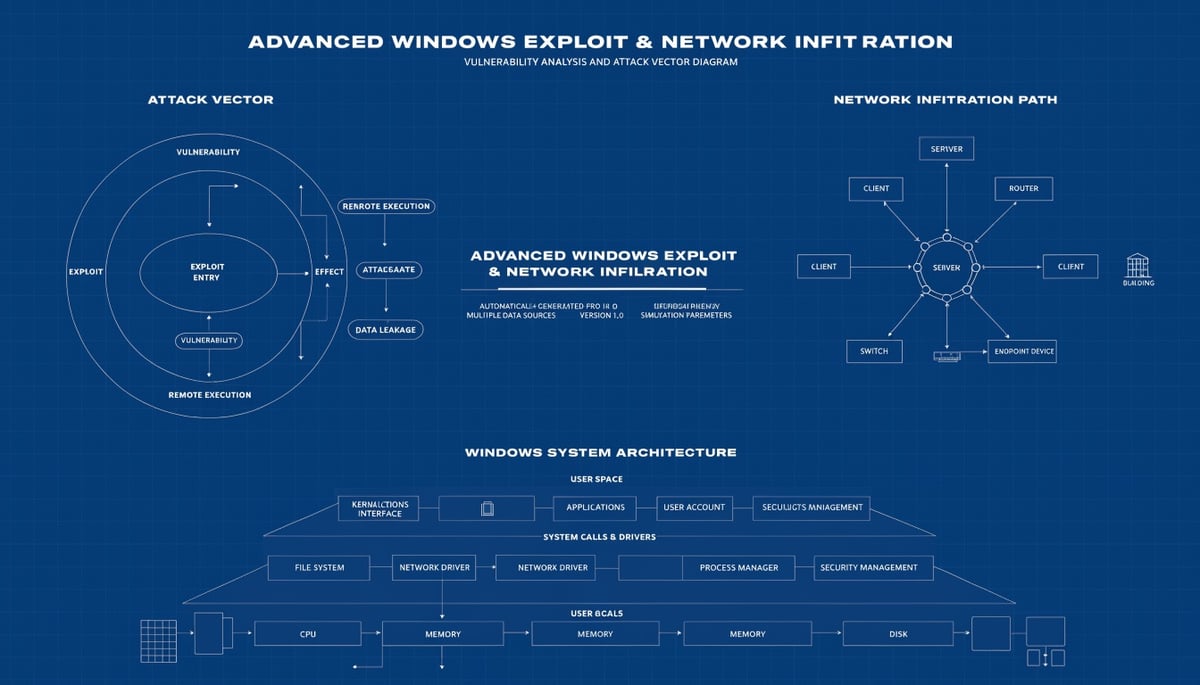
When attackers gain control of Active Directory domain administrator accounts, they essentially hold the master keys to an organization's entire digital kingdom. The June 2025 public sector breach demonstrates how a single compromised IIS server transformed into complete organizational control within 24 hours, with attackers gaining the ability to read all emails, manipulate data, and maintain persistent access across every connected system. (Source: Microsoft)
The business impact extends far beyond traditional data theft. With domain admin privileges, attackers can modify payroll systems, alter financial records, redirect wire transfers, and even lock legitimate administrators out of their own infrastructure. In this incident, the threat actor gained ApplicationImpersonation roles on Exchange Server and used Add-MailboxPermission commands to access every employee's email—exposing confidential communications, strategic plans, and potentially regulated data like healthcare records or financial information.
The speed of lateral movement makes containment nearly impossible once domain compromise occurs. Within the first day of this attack, the threat actor created scheduled tasks on domain controllers and initiated NTDS snapshot activities, effectively copying the entire organization's credential database. This meant every user password hash, service account credential, and administrative token was now in attacker hands—credentials that could be cracked offline and weaponized at will.
Password reuse amplifies the damage exponentially. The attackers' password spray attack unlocked access to at least 14 additional servers through credential overlap, demonstrating how poor password hygiene transforms a single breach into enterprise-wide compromise. Each compromised server becomes a new launching point for further attacks, creating a cascading failure that overwhelms security teams' ability to respond.
The operational paralysis from domain compromise often proves more damaging than data theft itself. Organizations cannot simply "turn off" domain controllers or reset all credentials without causing complete business shutdown. Email stops flowing, applications lose authentication, and employees cannot access critical systems. The recovery process—including krbtgt rotation, GPO cleanup, and ACL validation—typically requires weeks of intensive effort while business operations remain partially or fully suspended.
Financial exposure compounds through multiple vectors simultaneously. Beyond immediate incident response costs, organizations face regulatory penalties for data exposure, litigation from affected parties, and long-term reputational damage. The attackers in this case maintained access for over a month, from June to July 28, 2025, providing ample time to exfiltrate intellectual property, customer databases, and sensitive communications that competitors or nation-states could exploit for years.
The predictive shielding deployment midway through this attack revealed the stark difference proactive containment makes. Before activation, attackers freely pivoted between systems, deployed Godzilla web shells on multiple servers, and harvested credentials from Apache Tomcat servers using Invoke-Mimikatz. After predictive shielding went live, automated containment blocked not just compromised accounts but also context-linked identities on the same surfaces, forcing attackers to exhaust their credential reserves until they "lost momentum and stopped."
Without predictive capabilities, organizations face an impossible race where attackers move faster than defenders can investigate and respond. The threat actor's ability to compromise Schema Admin accounts—the highest privilege level in Windows environments—would typically guarantee total organizational compromise. Yet predictive shielding contained these accounts pre-abuse, transforming what should have been catastrophic escalation into blocked pivot attempts.
The Attack Chain: From Initial Compromise to Lateral Movement
The June 2025 attack unfolded across distinct phases, each revealing critical vulnerabilities in traditional security approaches. Understanding this progression illuminates why reactive defenses consistently arrive too late when facing sophisticated identity-based attacks.
The initial breach originated through a file-upload vulnerability in an internet-facing IIS server. Within minutes of establishing their web shell foothold, the attackers executed BadPotato token impersonation to escalate privileges to NT AUTHORITY\SYSTEM. This immediate privilege escalation represents a fundamental shift in attack velocity - where traditional breaches might take days to achieve administrative access, modern attackers compress this timeline to minutes.
Key Insight: This immediate privilege escalation represents a fundamental shift in attack velocity - where traditional breaches might take days to achieve administrative access, modern attackers compress this timeline to minutes.
The reconnaissance phase revealed methodical preparation for credential harvesting. Attackers enumerated domain groups using net group commands and AD Explorer, mapping the organizational structure before deploying Mimikatz to extract MSV, LSASS, and SAM credentials. This systematic approach ensured they understood exactly which accounts held value before exposing their presence through more aggressive techniques.
The critical inflection point occurred within 24 hours when attackers remotely scheduled tasks on domain controllers to initiate NTDS snapshot activities. Using makecab.exe to package the output created portable credential databases containing every Active Directory password hash in the organization. This single action transformed a contained breach into an existential threat - once NTDS data leaves the network, password resets become ineffective as attackers retain offline access to historical credentials.
Exchange Server compromise followed immediately, with Godzilla web shells providing persistent access to email infrastructure. The attackers enumerated ApplicationImpersonation roles and granted themselves full mailbox permissions using Add-MailboxPermission commands. This dual-pronged approach - combining directory credentials with Exchange delegation - created redundant access paths that survived individual account remediation attempts.
The timeline accelerated dramatically during the password spraying phase. Launching attacks from the compromised IIS server, threat actors unlocked access to at least 14 additional servers through credential reuse. This expansion occurred faster than security teams could identify and reset compromised accounts, demonstrating the fundamental challenge of credential-based attacks: defenders must protect every account perfectly, while attackers need only one successful authentication.
Key Insight: This expansion occurred faster than security teams could identify and reset compromised accounts, demonstrating the fundamental challenge of credential-based attacks: defenders must protect every account perfectly, while attackers need only one successful authentication.
Apache Tomcat servers became secondary targets when primary accounts faced disruption, with three servers compromised to harvest additional credentials using Invoke-Mimikatz. The attackers demonstrated remarkable persistence, pivoting to Microsoft Entra Connect servers using Impacket's WmiExec to extract synchronization credentials. Each blocked attempt triggered immediate lateral movement to alternative targets, creating a whack-a-mole scenario where containment efforts consistently lagged behind attacker actions.
The final phase involved desperate credential gathering attempts, including full LSASS dumps on file sharing servers using comsvcs.dll MiniDump techniques. Even as defensive systems severed active sessions, the attackers maintained momentum through July 28, 2025 - a full month after initial compromise. This extended dwell time occurred despite active defensive measures, highlighting how possession of valid credentials fundamentally alters the defender-attacker dynamic.
Traditional security boundaries dissolve entirely once domain-level credentials are compromised. The attack demonstrated that detection alone proves insufficient when attackers move faster than response capabilities can contain them. Each defensive action triggered immediate pivots to alternative credentials, creating an escalating cycle where remediation efforts actually accelerated lateral movement attempts.
June 2025 Attack Chain Progression
Initial Breach & Escalation
File-upload vulnerability exploited in IIS server, immediate privilege escalation to NT AUTHORITY\SYSTEM using BadPotato token impersonation.
Reconnaissance & Credential Harvesting
Systematic enumeration of domain groups and organizational structure. Deployment of Mimikatz to extract MSV, LSASS, and SAM credentials.
NTDS Extraction
Remote task scheduling on domain controllers to initiate NTDS snapshot. Packaging with makecab.exe creates portable credential databases containing all AD password hashes.
Exchange Server Compromise
Godzilla web shells provide persistent access. ApplicationImpersonation roles enumerated and full mailbox permissions granted via Add-MailboxPermission commands.
Lateral Movement Explosion
Password spraying from compromised IIS server unlocks 14+ additional servers through credential reuse. Expansion outpaces security team response capabilities.
Predictive Shielding: How Early Detection Stopped Escalation
Microsoft Defender's predictive shielding represents a fundamental shift from reactive to anticipatory defense, leveraging behavioral analytics to identify credential exposure moments before attackers can weaponize them. Unlike traditional signature-based detection that requires known malicious patterns, this technology monitors the contextual relationships between identities, devices, and authentication events to predict which accounts are likely compromised based on exposure indicators.
The system continuously evaluates three primary signal categories that indicate potential credential exposure. First, it tracks authentication anomalies including unusual service account activity, privilege escalation patterns, and cross-system authentication flows that deviate from established baselines. When the June 2025 attack involved Mimikatz deployment on the compromised IIS server, predictive shielding recognized the memory access patterns consistent with credential harvesting - not through signature matching, but through behavioral analysis of process injection and LSASS interaction patterns.
Second, the technology monitors identity exposure contexts by mapping which high-privilege accounts have active sessions on potentially compromised devices. This context-linking proved crucial when the attacker attempted to pivot from the initial IIS foothold. The system identified that Enterprise Admin and Schema Admin accounts had authenticated to the same server within the exposure window, automatically flagging these identities for preemptive containment even though they hadn't yet shown malicious activity.
The third signal category involves temporal correlation between credential theft indicators and subsequent authentication attempts. Traditional defenses wait for an account to perform malicious actions before responding. Predictive shielding instead recognizes that when ntdsutil snapshot operations occur on a domain controller, followed by makecab.exe packaging activity, credentials are being staged for offline extraction. The system immediately restricts any accounts with recent authentication to that domain controller, blocking their ability to authenticate elsewhere before the attacker can crack and replay them.
The technology's effectiveness stems from its ability to disrupt the attacker's decision loop. When the threat actor returned weeks later with Impacket tools including secretsdump and PsExec, predictive shielding had already restricted the exposed accounts based on earlier exposure signals. This forced the attacker into increasingly desperate pivots - attempting password sprays that exposed their presence, compromising Apache Tomcat servers as alternative credential sources, and ultimately exhausting their arsenal of compromised accounts.
What distinguishes predictive shielding from conventional endpoint detection is its focus on identity-centric kill chains rather than host-based indicators. When comsvcs.dll MiniDump operations targeted LSASS memory on the file sharing server, the system didn't just alert on the suspicious process behavior. It immediately evaluated which domain accounts had active tokens on that server, their privilege levels, and their potential lateral movement paths, then applied graduated restrictions based on risk scoring.
The containment actions themselves demonstrate sophisticated risk balancing. Rather than completely disabling accounts that might be business-critical, predictive shielding applies context-aware restrictions: blocking new interactive sign-ins while allowing existing sessions to complete, preventing lateral movement to high-value targets while permitting local resource access, and restricting privilege escalation attempts while maintaining service account functionality for critical applications. This granular approach prevented the business disruption that typically accompanies aggressive incident response while still neutralizing the attacker's ability to expand their foothold.
Immediate Actions: Containment and Investigation Priorities
When domain compromise is suspected or confirmed, every minute counts. The following prioritized actions focus on containing the blast radius while preserving evidence for investigation.
Immediate Actions (0-4 hours): Stop the Bleeding
First, isolate domain controllers from internet-facing systems without completely severing internal connectivity. Use Windows Firewall with Advanced Security to block inbound connections from compromised subnets: netsh advfirewall firewall add rule name="BlockCompromisedSubnet" dir=in action=block remoteip=192.168.1.0/24. This prevents attackers from executing remote scheduled tasks while maintaining essential authentication services.
Reset the krbtgt account password twice within 10 hours to invalidate all existing Kerberos tickets, including Golden Tickets. The double reset ensures tickets created between resets become invalid. Execute this through PowerShell on each domain controller: Set-ADAccountPassword -Identity krbtgt -Reset. Wait at least 10 hours between resets to allow ticket expiration across all systems.
Immediately disable PowerShell remoting on all non-administrative workstations to block WMI-based lateral movement: Disable-PSRemoting -Force. For servers requiring remote management, implement IP-based restrictions through Windows Firewall rules limiting connections to designated jump boxes.
Within 24 Hours: Forensic Triage and Scope Assessment
Query Event ID 4624 (successful logon) and 4672 (special privileges assigned) across all domain controllers for the past 30 days. Focus on Type 3 (network) and Type 10 (RemoteInteractive) logons from service accounts: Get-WinEvent -FilterHashtable @{LogName='Security';ID=4624,4672} | Where-Object {$_.Message -match "Logon Type:\s+(3|10)"}. This reveals which accounts attackers leveraged for lateral movement.
Examine scheduled tasks created remotely by querying Task Scheduler logs for Event ID 106 (task registered) with non-local principals. The NTDS snapshot activities described in the incident typically leave artifacts in %SystemRoot%\System32\Tasks with creation timestamps matching compromise windows.
Audit all accounts with ApplicationImpersonation roles in Exchange using: Get-ManagementRoleAssignment -Role ApplicationImpersonation | Format-Table User,AssignmentMethod. Document any assignments created within the attack timeframe, as these provide persistent email access even after password resets.
Short-term Actions (24-72 hours): Close Attack Vectors
Deploy Microsoft's official patches for any identified IIS file-upload vulnerabilities through Windows Update or WSUS. Temporarily disable file upload functionality on internet-facing IIS servers until patches are verified: modify web.config to set maxRequestLength="0" in the httpRuntime element.
Review and restrict delegation settings for all service accounts. Query unconstrained delegation: Get-ADComputer -Filter {TrustedForDelegation -eq $true} and Get-ADUser -Filter {TrustedForDelegation -eq $true}. Remove delegation privileges from any account not explicitly required for documented business functions.
Implement temporary ACL restrictions on sensitive groups (Domain Admins, Enterprise Admins, Schema Admins) allowing modifications only from designated secure administrative workstations. Use Set-Acl cmdlets to enforce deny permissions for all other sources until the environment is verified clean.
Detection and Monitoring: Identifying Similar Threats Before They Spread
Effective detection requires monitoring authentication patterns that deviate from established organizational baselines. Configure Windows Event Forwarding to centralize critical security logs from all domain controllers, focusing on Event IDs 4768 (Kerberos TGT requests), 4769 (Kerberos service ticket requests), and 4771 (Kerberos pre-authentication failures). These events reveal authentication anomalies that precede credential theft.
Set detection thresholds based on your environment's normal authentication volume. A single account requesting service tickets for more than five distinct servers within 10 minutes warrants investigation, as legitimate users rarely authenticate to multiple systems simultaneously. Similarly, flag accounts that generate Event ID 4625 (failed logon) across three or more systems within 30 minutes - this pattern indicates password spraying attempts using recently harvested credentials.
Monitor PowerShell execution logs (Event ID 4104) for encoded commands exceeding 1000 characters or containing Base64 strings with patterns matching -enc or -e parameters. The June 2025 attack used Invoke-Mimikatz through encoded PowerShell commands that would trigger this detection rule. Configure your SIEM to correlate PowerShell execution with subsequent outbound network connections to uncommon ports, as credential dumping tools often exfiltrate results immediately after execution.
Track service account authentication outside normal operational hours using Event ID 4624 with Logon Type 3 (network logon). Service accounts authenticating between midnight and 6 AM from workstations rather than servers indicate compromised credentials being tested. Create baseline profiles for each service account documenting their legitimate authentication sources, destinations, and time windows.
Deploy canary accounts - fake privileged accounts that exist solely to detect unauthorized access attempts. Position these accounts in Active Directory groups that attackers typically enumerate: Domain Admins, Enterprise Admins, and Backup Operators. Any authentication attempt using these accounts triggers immediate high-priority alerts, as they have no legitimate purpose. Name them realistically (svc_backup_admin or legacy_admin) to ensure attackers target them during reconnaissance.
Configure SIEM correlation rules to detect NTDS database access patterns. Monitor for Event ID 4662 on domain controllers with object type 19195a5b-6da0-11d0-afd3-00c04fd930c9 (Domain-DNS class), particularly when accessed by accounts that don't normally perform directory replication. Combine this with process creation events (Event ID 4688) showing ntdsutil.exe, vssadmin.exe, or wmic.exe shadowcopy execution on domain controllers.
Implement network-based detection for DCSync attacks by monitoring replication traffic outside established domain controller pairs. Configure your network monitoring tools to alert on Directory Replication Service Remote Protocol (MS-DRSR) traffic originating from non-domain-controller IP addresses. This traffic uses TCP port 135 for initial RPC connection followed by dynamic high ports for data transfer.
Create detection rules for abnormal scheduled task creation using Event ID 4698, particularly tasks created remotely (check the Creator Process Name field for svchost.exe with remote IP addresses). Tasks executing with SYSTEM privileges on domain controllers or containing paths to temporary directories require immediate investigation. The attack's remote scheduled task creation would trigger this detection within minutes of execution.
Preventing Recurrence: Hardening Against Domain-Level Threats
Preventing domain-level compromise requires fundamentally rethinking how administrative privileges are distributed and protected across your Active Directory infrastructure. The June 2025 incident revealed how attackers transform a single exposed credential into complete organizational control, but systematic hardening can break these attack chains before they reach critical mass.
Start by implementing tiered administrative models that segregate privileged accounts based on risk levels. Create three distinct tiers: Tier 0 for domain controllers and identity systems, Tier 1 for servers and applications, and Tier 2 for workstations. Administrators operating at Tier 0 should never authenticate to lower-tier systems where credentials could be harvested. In the June 2025 attack, the threat actor's ability to dump LSASS memory from workstations would have been meaningless if those systems never contained domain admin credentials.
Deploy Protected Users security groups to enforce Kerberos-only authentication for sensitive accounts. Members of this group cannot authenticate using NTLM, WDigest, or CredSSP protocols, eliminating entire categories of credential theft. Configure this protection using PowerShell: Add-ADGroupMember -Identity "Protected Users" -Members "Domain Admins". This single change would have prevented the attacker's password spray from succeeding against privileged accounts.
Implement Authentication Policy Silos to restrict where privileged accounts can authenticate. Create silos that bind domain admin accounts exclusively to domain controllers, preventing their use on member servers or workstations. When the attacker attempted to use compromised admin credentials on Apache Tomcat servers, authentication silos would have blocked these lateral movements entirely. Configure silos through Active Directory Administrative Center, assigning specific computer objects to each authentication policy.
Enable Windows Defender Credential Guard on all Tier 0 and Tier 1 systems to isolate credentials using virtualization-based security. This technology stores domain credentials in an isolated virtual machine that even kernel-level malware cannot access. The attacker's Mimikatz deployment would have failed to extract any usable credentials from systems with Credential Guard active. Deploy through Group Policy: Computer Configuration > Administrative Templates > System > Device Guard > Turn On Virtualization Based Security.
Reduce your domain admin footprint by implementing Just Enough Administration (JEA) endpoints for routine tasks. Create constrained PowerShell sessions that grant temporary, task-specific privileges without exposing full administrative credentials. For example, password reset operations don't require domain admin rights when properly delegated through JEA. This approach eliminates the need for help desk staff to possess privileged credentials that attackers frequently target.
Configure AdminSDHolder protection to prevent unauthorized modifications to privileged groups. Set the AdminSDHolder object's security descriptor to deny permission changes from non-authorized accounts, then reduce the SDProp interval from 60 minutes to 5 minutes for faster protection updates. This hardening would have prevented the attacker's attempts to manipulate group memberships and ACLs even after obtaining domain control.
Finally, implement domain isolation through IPsec policies that require mutual authentication between domain members. Configure policies that enforce encrypted, authenticated communication for all domain controller traffic. This network-level protection ensures that even with valid credentials, attackers cannot communicate with critical infrastructure from compromised edge systems like the IIS server that initiated this breach.